Embodied Life – A New Painting Project
(Text in Deutsch siehe unten / Text in German below)
My ongoing project, Embodied Life, consists of several paintings, each featuring one or two three-dimensional pictorial elements. It builds on my artistic work in recent years, in which I have primarily reflected on philosophical questions concerning the essence of life, nature and the interconnectedness of different forms of life.
In my current project, I explore the creative aspects of life—particularly the emergence of life, growth, development, transformation, sexuality and reproduction—as well as the interconnectedness of living beings. In my latest paintings, I consider these aspects from a perspective that encompasses both the human world and all other forms of life on Earth. This perspective is grounded in the idea of an “Earth community” that includes all living beings and connects them in diverse and reciprocal ways. These aspects recur in similar ways across different forms of life. They form the basis of what defines life and shapes it in multifaceted ways.
In my paintings, these aspects are symbolically represented through one or more three-dimensional visual elements and their dynamic relationship with the pictorial space. The individual tangible forms are the protagonists at the centre of my paintings. Each possesses an essential presence and a personality of its own. Through combinations of organic and geometric forms, artificial and natural colours, and through their expansion and movement within the pictorial space, they embody different forms of vitality. They can be interpreted as living objects, living beings or hybrids. As representatives of all forms of life, they embody the principle of coexistence on equal terms.
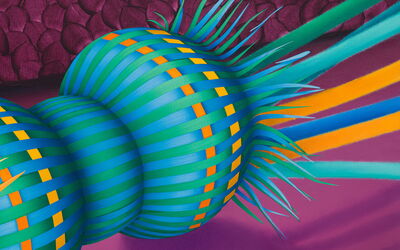
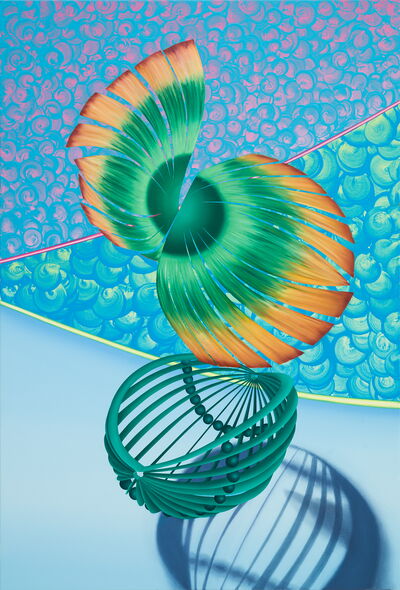
Through the way they extend across the pictorial space, the three-dimensional elements reveal different forms of expression and movement. In one painting, for example, they suggest unfolding and a sense of striving upwards. In another, the three-dimensional element stretches diagonally across the pictorial space, creating an impression of tension and apparent growth in opposing directions.
The individual three-dimensional pictorial elements in the paintings are based on small three-dimensional paper objects developed in advance. Their forms are determined by various basic geometric shapes, which I develop through drawings and either expand upon or design from scratch for each project. Over time, this process gives rise to increasingly complex paper objects. Their construction reflects processes found in nature, where many things are based on simple forms, geometric patterns or specific principles. The designs are developed both pragmatically and aesthetically, within the limitations and possibilities of paper as a material.
At first glance, the formal and chromatic language of the paintings may not appear to be directly connected to our reality. Nevertheless, they explicitly engage with the here and now—with a vibrant and diverse world. By superimposing multifaceted aspects of our existence—situated at the intersection of nature, technology and digitality, and shaped by ongoing processes of transformation—the paintings create entirely new images of our world.
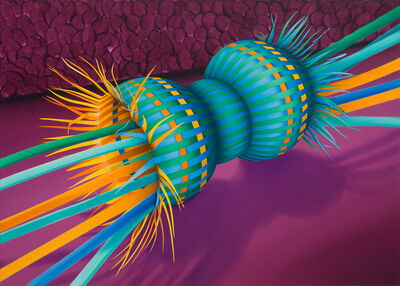
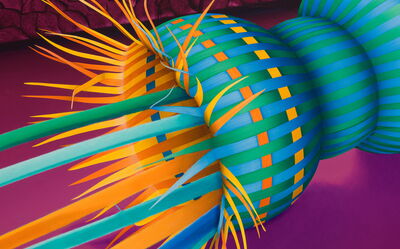
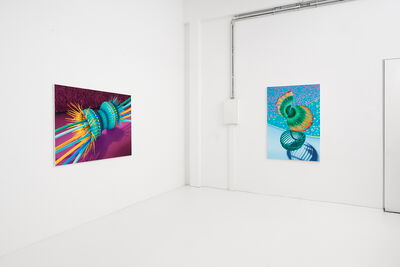
The paintings created thus far as part of the project are medium-sized and each depicts only one or two pictorial elements. The work Connecting Piece – Weave of Sensation is based on two interconnected ideas. On the one hand, it arose from the desire to depict a web of life, a nexus or a network of relationships that connects two or more things. On the other hand, the work was inspired by the form of a vase and the structure of woven baskets made from wild grass. Another source of inspiration is Elizabeth Fisher’s writing 'The Carrier Bag Theory of Human Evolution'. Ursula K. Le Guin also refers to this text in her essay 'The Carrier Bag Theory of Fiction'. In it, Fisher describes the development of humanity and culture as an act of caring cooperation rather than—as conventional narratives often suggest—as a mere struggle for existence involving weapons. She emphasises the importance of containers, such as bags, foraging pouches and baskets, as some of humanity’s first essential tools. At the heart of her argument is the fundamental importance of gathering and preserving food and other objects. In the painting, the interior held within the ‘woven vessel’ symbolically opens out to two opposite sides – like a seed that breaks open and unfolds. It divides, expands and enters into new connections with the infinite network of life. From another perspective, various independent strands connect to form a network at the centre of the painting before opening up again and forming new connections. As Ursula K. Le Guin writes: “Nothing in the universe is separate; nothing acts in only one direction.”
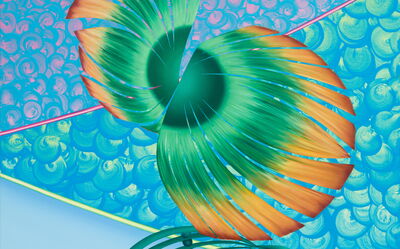
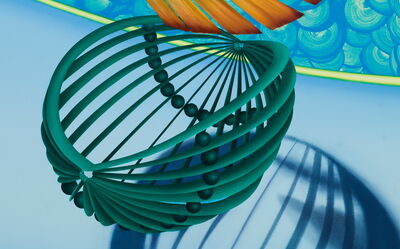
The painting Awakening – Born of Wing Vibrations is inspired by the process of life’s creation and development, as well as the journey of awakening and rising upwards. A wing-like being, shaped from the curves of a sphere, seems to emerge from a form reminiscent of a small basket, bowl or boat. This shape derives from the form of an egg—a symbol of the protective shell from which new life is born.
The paintings oscillate between spatial realism and staged scenes, presenting a novel and unfamiliar visual world. They invite viewers to contribute their own thoughts, associations and ideas, allowing new images and stories of our world to emerge. In this way, the works open up unfamiliar perspectives, encouraging us to rethink and retell our history on Earth.